




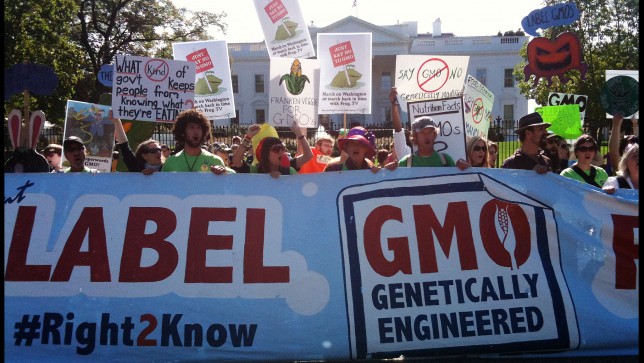
In a major victory for consumers and food right-to-know advocates, a U.S. federal district handed down a final remedy decision last month in the long-running litigation over the U.S. Department of Agriculture’s (USDA) regulations for the first-ever U.S. disclosures of genetically engineered (GE or GMO, now known as “bioengineered”) foods.
A previous court of appeals decision had held several rule provisions unlawful but left the remedy implementation to the lower court to decide, which has now been issued after further legal briefing.
“This decision was the final nail in the coffin of the 2021 unlawful GMO labeling regulations,” said George Kimbrell, Legal Director for CFS and counsel in the case. “We are gratified that the district court, like the court of appeals before it, has agreed with our legal arguments and struck them down.”
The Litigation
The case challenged the USDA rulemaking first applying the National Bioengineered Food Disclosure Standard, a 2016 federal law that for the first time in U.S. history mandated the labeling of genetically engineered foods. But in its original rule, USDA exempted “highly refined” or ultra-processed GMO foods—such as corn and soy oils—from any disclosure.
This loophole was significant, as these GMO ultra-processed foods, such as sodas and cooking oils, make up approximately 70% of all GMO food ingredients. It had also allowed companies to disclose solely through inaccessible digital “QR code” labels, instead of on-package text or symbols, despite the fact that USDA’s own report had found that such disclosures would be discriminatory by not providing the relevant information to many segments of the public. Both decisions became central to the litigation.
After over four years of litigation, in late 2025 a U.S. Federal Court of Appeals issued a detailed 50+ page opinion agreeing with the challengers and concluding that USDA had acted unlawfully in excluding ultra-processed foods from the bioengineered disclosure standard. It also held that the “QR code” labeling provision, which the lower court had held unlawful, had to be struck down.
What Happens Now
Last month’s decision clarifies the timeline for which USDA must redo the rulemaking. While the agency fought to delay updates until 2029, the district court rejected this timeline, instead agreeing with the plaintiffs that the provisions are legally void by January 1, 2028. USDA is now anticipated to issue new, redone rules to implement both provisions in the next year.
“Ten years have passed since Congress mandated adequate disclosure of GMO ingredients on food packaging. Now, after a very long detour, we can look forward to working with Secretary Rollins to implement sound and sensible rules as intended by the statute,” concluded Alan Lewis, Vice President of Advocacy & Governmental Affairs at Natural Grocers, a plaintiff in the case.
In the litigation, CFS represented a plaintiff coalition of nonprofits and organic retailers: Natural Grocers, PCC Natural Markets, Good Earth Natural Foods, National Organic Coalition, Citizens for GMO Labeling, Label GMOS, and Rural Vermont.


(4 votes, average: 4.75 out of 5)
 Loading...